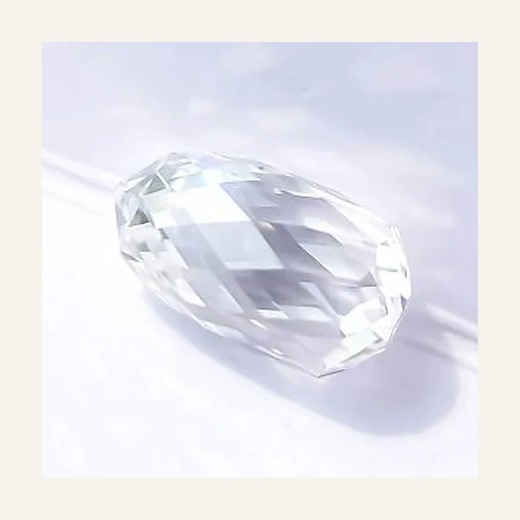
A pear-shaped head is not symmetrical: one end is a point, the other is a round belly. A straight band will either clear both ends or collide with the belly, and there is no way to tell from a top-down photo.
Look at the side profile
Put the ring on a table and look at it from the side. If the band runs flat into the head, a straight band works. If the head sits on a gallery with space underneath, a straight band will stop against the shoulders and leave a wedge-shaped gap.
Photograph it side-on with a ruler in frame. The distance from the band's edge to the head, and the height of the gallery, are the two numbers a jeweller needs.
The three matching shapes
- Straight band — only for a low-set pear where the head does not overhang. Clean, modern, easy to wear.
- Contoured band — a smooth curve that follows the round belly of the pear. The most common solution, and the hardest to get right: the radius has to match the head.
- Chevron / V-band — a sharp V that points along the pear's tip. It reads deliberate and works well when the pear is set east-west or at an angle.
East-west settings
A pear set horizontally changes the geometry completely: the point faces sideways, so the band needs a symmetric curve or an open section. If you are matching a band to an east-west pear, send the photo before choosing anything.
What about two bands?
A contoured band on one side and a straight band on the other is a common solution: the curved band sits against the engagement ring, the straight band outside it. It also lets you wear the straight band alone.
Metal and finish
Match the engagement ring's metal or contrast deliberately. If you match white gold, remember that rhodium wears faster on a plain band than on a stone-set ring, so the two can drift in colour within a year.
Send a side-on photo and the ring size — we will tell you which of the three shapes will sit flush before you order. Wedding bands →

The people who cut the stones and set the rings. We publish what we can verify on our own bench, and link to the certificate or the guide when a number needs a source.
